

Pre-K Program
What will my child actually be doing in Pre-K?
This is the year the work gets real. A few examples from what we teach and track:
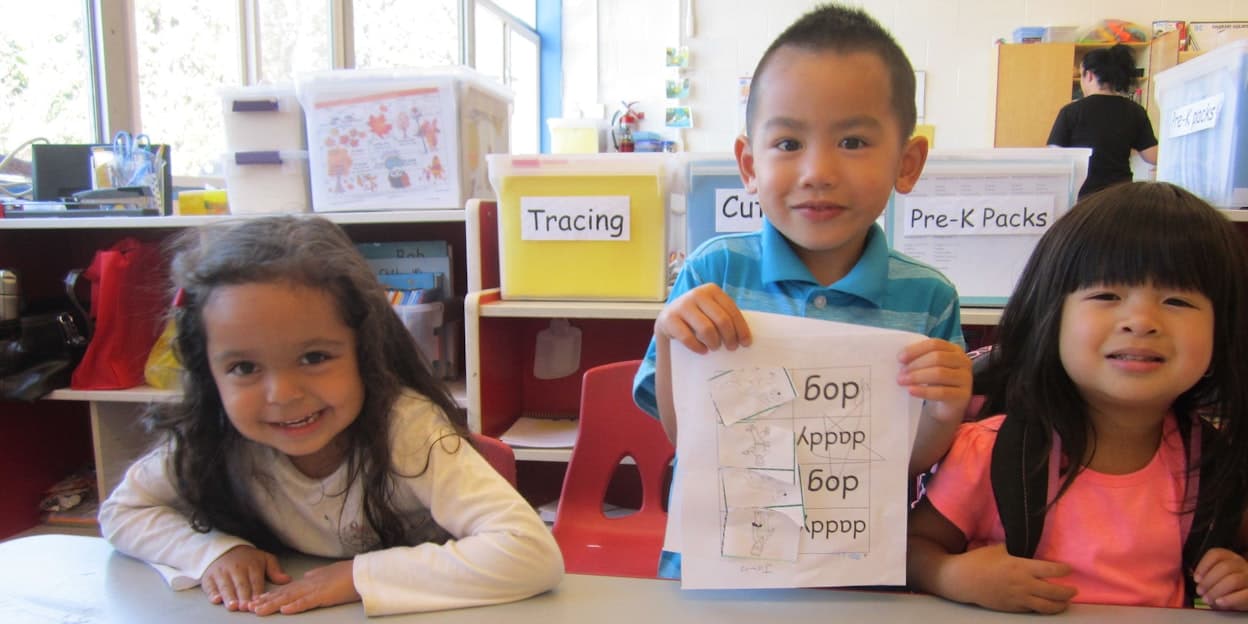
- Reading and writing. Working up through twenty book levels, writing their own name, tracing both big and small letters.
- Numbers. Counting to fifty and writing numbers to thirty.
- Hands and body. Twenty-piece puzzles, climbing the rock wall, hanging from a trapeze bar for thirty seconds.
Each of these is checked off for your child individually, not for the class as a whole.
How does Elan teach children at different levels in the same class?
By teaching the child rather than the class. If seven children have the alphabet down and three are still learning it, those seven move on to what comes next and the three keep working on the letters they actually need.
Nothing about that is unusual to us, it is just how the day is built. Your child is never held at the pace of the group, and never pushed past something they have not got yet.
How is reading taught in Pre-K?
Every morning, as its own class, and every child is at their own level in it. Over the Pre-K years children work up through twenty book levels.
Alongside the reading itself they learn the consonant and short vowel sounds, rhyme nonsense words, and name the first letter of a word from its sound. Those three things are what let a child read a word they have never seen before, which is the difference between reading and memorizing.
Children who are further along read aloud to the others. They enjoy it, and it is also how we know they have really got it.
What does science look like in Pre-K?
Ten subjects over the year: the five senses, water, color, crystals, plants, animals, magnets, wind, suction and light.
All of it done by hand. Children grow crystals and watch them appear over days, find out which things a magnet pulls and which it ignores, and work out what suction is by using it. Nobody is memorizing definitions. They are finding out that the world behaves in ways you can predict, which is the part that lasts.
Plants are the subject that runs longest. Children plant seeds in our garden, water them, and keep looking after them well after the novelty has worn off, which is most of the lesson. Taking care of a plant is on the list of abilities we track at home too.
How much of the day is play?
Hours of it, outdoors, every day. Mid-morning is snack, trikes, running around, playing on our large structures. Afternoons come back outside again.
The physical skills are tracked like everything else: the rock wall, the monkey bars, obstacle courses, hopping ten times on each leg, walking on stilts around the school. Children this age learn with their whole body, and three and four-year-olds who have run for an hour sit still afterwards in a way that ones who have not simply cannot.
What happens after lunch?
Children who still nap, nap. Children who do not go to their afternoon classes instead, so nobody spends an hour lying awake on a cot.
Those classes are workbooks one day and hands-on work the next: sorting, patterning, pegboards. The day finishes with snack, art, music and more time outside. Art here means real work, watercolors and mixing colors, collage and papier-mâché.
What is my child expected to do at home?
We track abilities at home as carefully as the ones at school, and we ask you to work on them with us. Dressing themselves, lacing their own shoes, buttons and zips and buckles, pouring a glass of water, cracking an egg, knowing their full name, birth date and phone number, and doing one regular job at home every day.
This is the part of our program that surprises parents most, and it is deliberate. A child who can do things for themselves carries that into the classroom. They ask for help less, they try first, and they recover from getting something wrong faster. We call it self-determinism, which just means a child learning to make their own choices and act on them.
What is my child ready for after Pre-K?
Academically, reading simple books on their own and writing their own name. But the abilities that decide how kindergarten actually goes are the quieter ones, and we track those just as closely:
- Work on their own for much of a class without being kept on task
- Take regular care of an area of the school
- Sort out a disagreement with another child before an adult steps in
- Clean up their own area, and then a larger one, without being asked twice
- Set an example for the younger children, and know they are doing it
You will see it happening as it happens. We track every child against an ability checklist and go through it with you at regular intervals, and you can ask for a copy whenever you want one.