

Tots Program
What will my two-year-old actually be doing?
More than most people expect at this age. A few examples from what we teach and track:
- Letters and reading. Recognizing and saying the letters in cat and dog, and reading their own name.
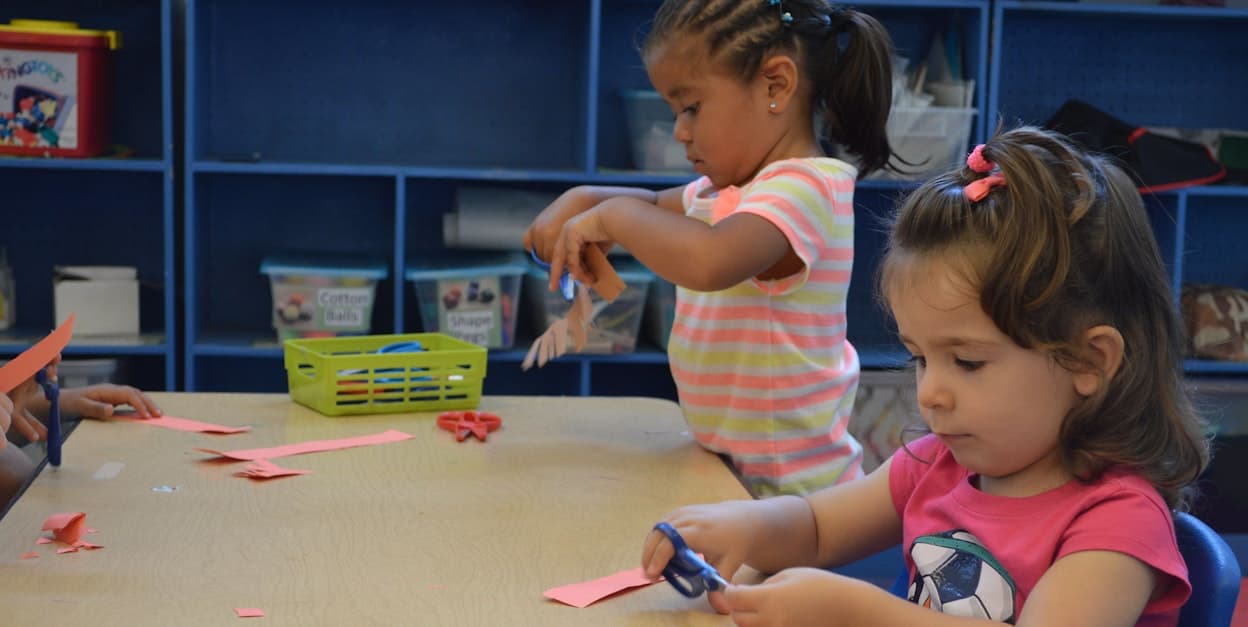
- Hands. Scissors from a first straight line through to cutting out a triangle, tracing shapes, lacing beads.
- The yard. Pedalling a trike, climbing a ladder, hanging from a trapeze bar.
Every one of these is taught deliberately and checked off for your child individually rather than for the class as a whole.
How many children share a teacher in the Tots class?
Nine. Our two-year-old classes run at no more than nine children per teacher, where many programs run twelve.
Those three children are the difference between a teacher who reacts and a teacher who notices. At this age most of the learning happens in small moments: the pause before your child tries a word, the second attempt at holding a pencil. A teacher watching nine children catches those. A teacher watching twelve is managing a room.
Do two-year-olds really learn from each other?
Yes, and faster than most parents expect. A two-year-old who has just worked out a letter will turn to the child beside them and show them. That child tries it because someone their own size did it first, not because an adult asked.
We build the day around that. Children work at their own level but sit together, so a child who is ahead gets to explain and a child who is behind sees it done by a peer rather than a grown-up. Explaining is also how the first child proves they actually know it.
Do two-year-olds do science?
Yes. Over the year the Tots cover the five senses, water, light, plants, animals, magnets and wind.
Not as lectures, obviously. A two-year-old learns what a magnet does by finding out which things in the room stick to it. What they take away isn't the vocabulary, it's the habit of trying something to see what happens, which is the part that matters later.
What is my child ready for after the Tots class?
By the time your child moves up, they can:
- Read their own name, and words like cat, dog, mommy and daddy
- Recognize and say the letters in each of them
- Name six colors on sight
- Cut a straight line, then a square
- Trace shapes and draw a circle
- Stay with a fifteen-minute art project until it's finished
None of that is our impression of how they're doing. We track every child against an ability checklist covering reading, writing, dexterity, science and physical skills, and we go through it with you at regular intervals. Ask for a copy whenever you want one.
That's what Pre-K is built on. Children arrive already able to learn in a group, so the reading program starts on day one instead of spending a term on how to sit in a classroom.